

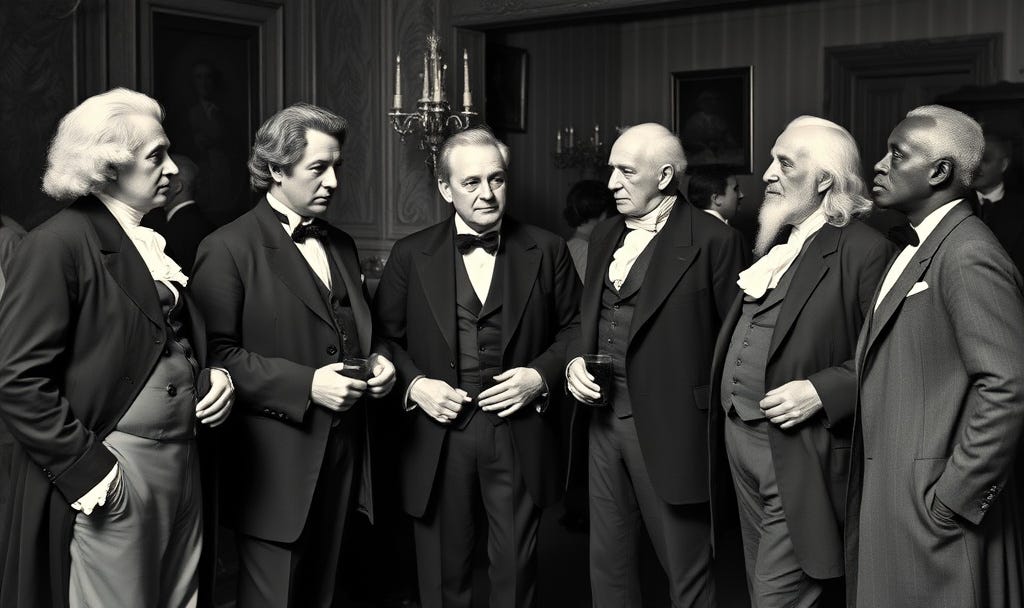
The doors open. The room fills.
Gathered together from two and a half centuries, the people in this room are here to discuss the relationship between education and democracy.
Thomas Jefferson arrives first and takes his place near the center. “An educated citizenry,” he says to no one in particular, “is a vital requisite for our survival as a free people.”
Horace Mann nods from across the room. “A human being is not, in any proper sense, a human being till he is educated.” He pauses, “….and a republic — a republic cannot remain ignorant and free.”
John Dewey says: “Democracy has to be born anew every generation, and education is its midwife.”
People didn’t end up in this room by accident. There is a proposition on the table. It is about a question about practicing democracy that has been swirling around since the beginning of the country.
There is a quiet concern that the connection between education and democracy is more fragile than anyone would like to admit.
They do not want to talk about democracy as a governing practice, but as something that has to be lived, practiced, and yes, taught.
Democracy: Lived. Taught. Practiced. Every. Day. That is what everyone is here to explore.
So, what does that actually look like?
The conversation will not be about democracy as a credential…or as a sorting mechanism…or as a ladder to success. It will be about education as the practice of democracy itself. The daily, repeatable, habit of self-government.
W.E.B. Du Bois speaks: “The object of all true education is not to make men carpenters, it is to make carpenters men.”
Frederick Douglass, who learned to read in secret and understood earlier than most what lack of literacy threatens, says: “Education means emancipation. It means light and liberty.”
Benjamin Franklin brings it back to the ground: “An investment in knowledge pays the best interest.”
……but what kind of knowledge? For what purpose? Toward what end? Where is the power, and who has control? Who decides?……and who decides who decides?
These are the questions that have brought everyone to this event. The questions are deceptively simple and deep at the same time. Can democracy be taught? What keeps it going? Can it be practiced into existence, or is it more fragile than that? Is it something that must be consciously rebuilt in every generation by every citizen? How does self-government protect itself from authoritarian leadership?
You have just read the introduction to a series about the relationship between a successful and sustainable democracy and a well-supported public school system. Over the next few weeks, this conversation will be brought to you in five parts.
I. The Young Republic Needed Educated Citizens
II. When Democracy Expanded, Public Schools Expanded
III. Democratic Localism, Professionalism, and School Governance
IV. Rights, Courts, and Democratic Tension
V. Most Civic Questions Continue Today
What do you want to hear thought leaders explore about education and democracy?
This is enlightening, and very clearly shows what these famous people’s intentions were in creating our country, and advancing democracy.